Facts of the Case
In 1794, Congress enacted a tax of sixteen dollars on each carriage owned by an individual or business. Hylton viewed the law as a direct tax in violation of the constitutional requirement that taxes passed by Congress must be apportioned, that is, laid according to the population and the number of representatives from each state.
Questions
Was the carriage tax a direct tax, which would require apportionment among the states?
Conclusions
-
The Court concluded that the carriage tax was not a direct tax and thus that the carriage tax did not violate the Article I, Section 2, Clause 3 and Article I, Section 9, Clause 3 requirements for the apportioning of direct taxes. The Court reasoned that direct taxes did not include taxes on the possession of goods.
Applying the Founders' Originalism
Federalist Society Review, Volume 26
The 1787 Federal Convention drafted, and the ratifiers approved, the United States Constitution under the...
Moore v. United States and the Uncertainty About “Direct” and “Indirect” Taxes
Our Constitution distinguishes between direct and indirect taxes. Indirect tax rates must be uniform throughout...
A Deeper Originalism: From Court-Centered Jurisprudence to Constitutional Self-Government
Federalist Society Review, Volume 24
Originalism has substantially reoriented constitutional discourse since it first reemerged in response to the Warren...
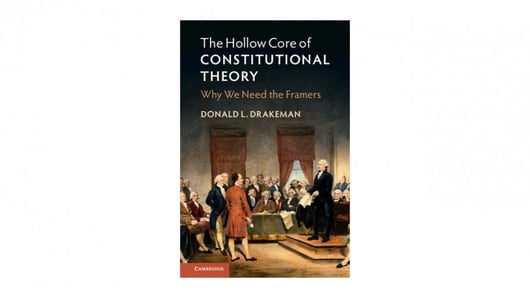
Should the “Hollow Core” of Constitutional Theory Be Filled with the Framers’ Intentions?
Federalist Society Review, Volume 22
A Review of The Hollow Core of Constitutional Theory: Why We Need the Framers, by...

The Many Issues Raised by Senator Warren's Wealth Tax
Senator Warren, as a part of her presidential campaign, has proposed that a federal wealth...